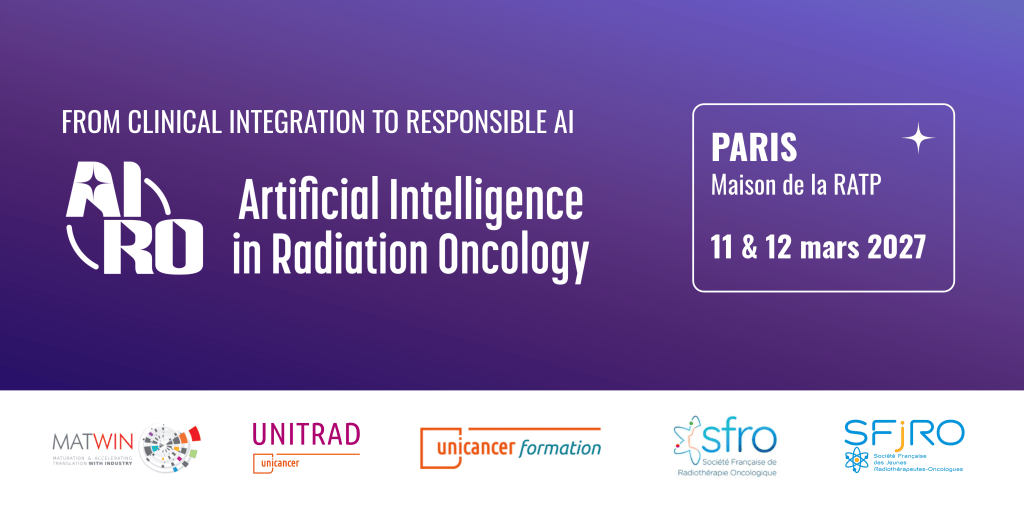
Artificial Intelligence in Radiation Oncology 2027
Dernière mise à jour : 06/11/2026
Description
From Clinical Integration to Responsible AI
March 11 and 12, 2027
Registration deadline: March 4, 2027
This 1.5-day international in-person scientific course combines expert presentations, clinical applications and practical workshops focused on artificial intelligence in radiation oncology.
THURSDAY, MARCH 11 – FULL-DAY TRAINING
9:00–9:15 | Opening Session
Introduction to the course and educational objectives.
9:15–11:00 | Session 1 – Advanced AI Methods
Deep learning, predictive models, large language models, generalizability, uncertainty, model evaluation and quality assurance.
11:00–11:15 | Coffee Break
11:15–13:00 | Session 2 – Proton & Particle Therapy
AI across the proton therapy workflow: contouring, planning and dosimetry, image guidance and adaptation, clinical perspectives.
13:00–14:00 | Lunch
14:00–15:45 | Session 3 – AI for Reirradiation
Multimodal image registration and dose accumulation; automated segmentation in previously irradiated anatomy; prediction of efficacy and toxicity; AI-supported clinical decision-making.
15:45–16:00 | Coffee Break
16:00–17:45 | Session 4 – AI Governance
Regulatory frameworks; clinical validation; risk assessment and human oversight; model monitoring and drift; accountability and organizational governance.
17:45–18:00 | Final Discussion and Closing Session
Open-floor discussion with all participants, live course evaluation, closure.
FRIDAY, MARCH 12 – MORNING TRAINING
9:00–10:45 | First Series of Workshops
Participants choose one workshop from:
-
Workshop 1 – Advanced AI Methods
-
Workshop 3 – AI for Reirradiation
-
Workshop 4 – AI Governance
10:45–12:30 | Second Series of Workshops
Participants choose one workshop from:
-
Workshop 1 – Advanced AI Methods
-
Workshop 2 – Proton & Particle Therapy
-
Workshop 4 – AI Governance
Places are subject to availability.
Workshop Content
Workshop 1 – Advanced AI Methods
Hands-on model evaluation, segmentation, performance metrics, uncertainty and quality assurance.
Workshop 2 – Proton & Particle Therapy
Clinical case: AI-assisted contouring, planning, optimization, robustness, image guidance and adaptation.
Workshop 3 – AI for Reirradiation
Clinical case combining registration, cumulative dose assessment, segmentation and decision support.
Workshop 4 – AI Governance
Implementation pathway for an AI tool: risk analysis, human oversight, monitoring and responsibilities.
12:30 | Closing Session
Live course evaluation, closure. End of AIRO training.
ADDITIONAL EVENT – FREE PROTON THERAPY SYMPOSIUM
Friday, March 12, 2027 – 14:00–16:30
AIRO participants are invited to attend the Unicancer Proton Therapy Symposium, offered free of charge.
This scientific event will explore the latest innovations and future developments in proton therapy.
The symposium is offered exclusively to AIRO participants and is not included in the training programme or its educational duration.
Complimentary Proton Therapy Symposium – March 12, 2027
Registration for the 1.5-day AIRO training programme automatically includes free registration for the Unicancer Proton Therapy Symposium, held on March 12, 2027, from 14:00 to 16:30.
Participants will receive a separate registration confirmation, including the symposium programme and practical information.
Objectifs
By the end of the training, participants will be able to:
-
Identify the main uses and challenges of artificial intelligence in healthcare
-
Explain the main applications of AI in medical physics and proton therapy
-
Analyse the ethical, regulatory, organisational and governance issues associated with the deployment of AI in healthcare
-
Identify the conditions required for the safe, reliable and responsible integration of artificial intelligence solutions into professional practice
-
Assess the benefits, limitations and key points of vigilance associated with the use of AI in their professional environment
Public visé
Prérequis
Modalités pédagogiques
-
Informative method: Theoretical input and knowledge sharing.
-
Applied method: Practical exercises through simulations and case studies.
-
Experience analysis: Collective review and discussion of real-life feedback.
Moyens et supports pédagogiques
Training Resources and Materials
-
Educational resources and training materials provided to participants
-
Case studies and experience sharing
-
Opportunities for discussion and exchange of professional practices between participants and experts
Venue and Facilities
-
The training will take place at RATP House – 54 Quai de la Râpée, Paris
-
Participants will be welcomed in facilities suitable for training sessions, conferences and professional discussions
-
The equipment and facilities required for the proper delivery of the training will be available on site
Modalités d'évaluation et de suivi
Assessment procedures
Before the training
Placement questionnaire
During the training
Formative and summative assessments
After the training
Learning outcomes assessment quiz
Satisfaction questionnaire
Accessibilité pour les personnes en situation de handicap
Accessibility for People with Disabilities
Unicancer Formation has a designated disability officer.
They provide information and support to participants with disabilities and ensure that everyone can access the training under the best possible conditions.
Contact : David Aubry d-aubry@unicancer.fr
Our trainers are aware of and trained to welcome participants with disabilities.
Unicancer Formation is committed to promoting diversity and inclusion. All applications are reviewed on an equal opportunity basis.
Before the training
Please contact us as early as possible by email at unicancer-formation@unicancer.fr to inform us of any specific needs or accommodations required.
You are welcome to complete the dedicated form questionnaire to help us better prepare your participation
On the Day of the training
A member of the Unicancer Formation team will welcome you 30 minutes before the start of the session.
During the training
The trainer will implement the accommodation measures previously identified with you before the course.
Accessibility Register
The accessibility register of our training organization is available upon request at unicancer-formation@unicancer.fr.
Support Measures
We invite you to explore the support and assistance measures we offer, available by clicking the link below ici.
Délais d'accès
Registration deadline: 4 March 2027
Registration is open until 7 days before the start of the training, subject to availability.
For any questions regarding registration:
unicancer-formation@unicancer.fr
Tarif
Organisational Features
-
Lunch included
-
Transport and accommodation at trainees' expense
Accessibility
Accessible to people with disabilities.
For any specific request, please contact our disability officer.
Profil du / des Formateur(s)
This programme is conducted by a multidisciplinary panel of international experts recognised for their excellence in both clinical practice and research.
The teaching team includes:
-
Radiation oncologists and medical physicists, leading or contributing to AI-based clinical projects in radiotherapy, proton therapy and dosimetry.
-
Professors and researchers in data science, applied mathematics, and biomedical informatics, specialised in algorithm development, model validation, and medical data integration.
-
Experts in ethics, governance and digital law, addressing the legal, regulatory, organisational and societal challenges associated with artificial intelligence in healthcare.
Together, they provide participants with a comprehensive and operational understanding of how artificial intelligence is transforming radiation oncology, from clinical applications to ethical and regulatory frameworks.